Meet the Georgian team
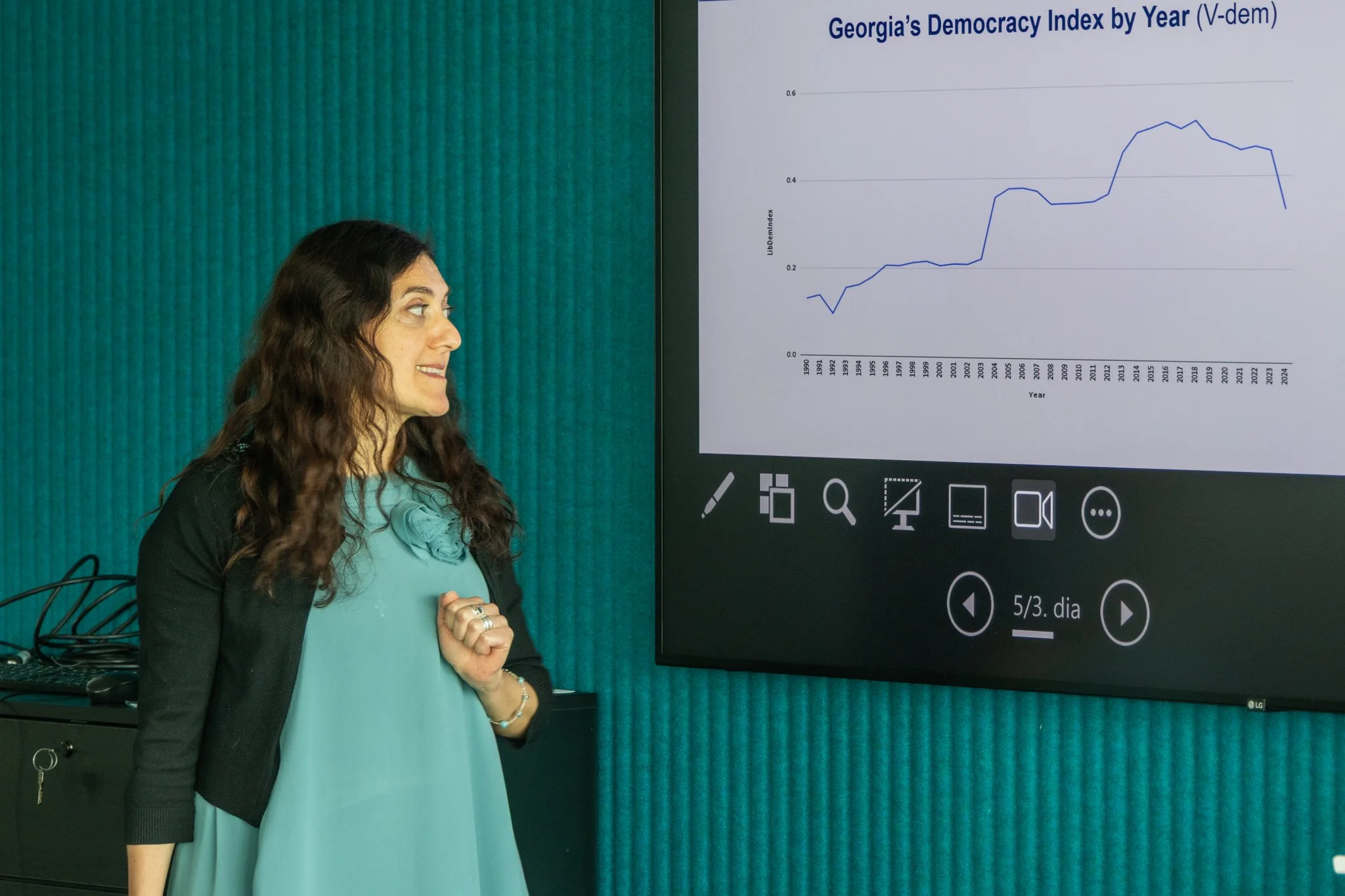
Interviewee for the Georgian project group is team leader Lia Tsuladze. The project group consists of five women, four researchers and one financial manager. The researchers are mostly sociologists, but also a psychologist and a political scientist.
What can you tell me about your research background?
I'm a cultural sociologist and since Georgia’s signing of EU Association Agreement in 2014, I have been working on political, media and popular discourses on Georgia's Europeanization, as well as the rise of informal governance and its impact on political decision-making and protest movements. I began by studying environmental protest and examining how informal practices and oligarchic power structures affected environmental activism in Georgia. Over time, however, Georgia's de-Europeanization and de-democratization changed the landscape significantly. Georgia's democratization had progressed within the framework of its Europeanization, so when that process was reversed, it affected all democratic institutions and triggered large-scale political protests. Today, environmental activists, LGBTQ activists, workers, students, and other groups all fight together against authoritarian rule under the Europeanization framework. As a result, my research has gradually shifted from environmental and policy-oriented activism toward political activism.
What movements are you studying?
We study both pro-democratic and anti-democratic protests, with a special focus on the former.
In practice, the main anti-democratic mobilizations are those organized by or aligned with Georgia’s ruling party. One example is the annual event held on May 17. Internationally, May 17 is recognized as the day against homophobia. In Georgia, however, when activists gathered to oppose homophobia, the ruling party argued that there was no place for what it called "LGBTQ+ propaganda". Clergy members and their supporters often confronted small groups of activists, and despite the presence of police, authorities frequently failed to ensure their safety.
A particularly serious incident occurred in July 2021. The situation had become so dangerous that the planned rally was cancelled. Journalists still came to cover the events, but right-wing groups attacked them in the streets. One journalist later died from injuries sustained during the violence. Since then, the government has promoted May 17 as the Day of Family Purity and Protection of Children, suggesting that traditional family values require special protection on that date.
As noted, our major focus is on the current pro-European and anti-regime protests. A series of large-scale pro-European protests was launched in Georgia in March 2023, in response to the ruling party’s introduction of the so-called “foreign agents” law against civil society. Because of a massive 3-day protest, the draft law was withdrawn but it was reintroduced next spring, triggering a 50-day public protest. After the adoption of this law on May 28, 2024, the authoritarian rule in Georgia rapidly consolidated, followed by other repressive laws such as those banning "LGBTQ+ propaganda” and opposition parties. However, the situation escalated after November 28, 2024, when the ruling party suspended Georgia’s European integration and started using especially harsh measures against the protesters involved in continuous pro-European and anti-regime protests. The protesters have been subject to not only the police’s physical violence or extremely high fines for covering faces against smart cameras attached around the protest venues, but also imprisonment for blocking central roads and even sidewalks, as well as criminalization for openly criticizing or even mocking government officials.
Has anything surprised you during this research so far?
What has surprised me most is how differently the same social issues are perceived by participants in pro-democratic and anti-democratic protests. Both groups interpret and mobilize current social problems in completely different ways.
Issues that pro-democratic activists frame as human rights, democracy, and European values are often perceived by anti-democratic groups as sources of moral panic and social threat. This creates a deep value-based conflict that is extremely difficult to overcome. It is not simply a political disagreement. It reflects fundamentally different understandings of society and morality. That realization made me understand that political and societal polarization is a much deeper and longer-term challenge than I had previously assumed.
For years, Georgian society has been highly polarized, but with one important exception: support for European integration. More than 80 percent of the population consistently supported Georgia's European path, so we believed this issue united the society despite other divisions. What I have come to realize is that the underlying conflicts were always there. Even when they were not visible on the surface, they existed beneath it. European integration appeared to be an area of consensus, but it was also connected to deeper disagreements about values, identity, and the future direction of society.