ProTest project Newsletter #3
Dear ProTest project community,
We are delighted to share with you the project’s third newsletter - we are thrilled to share what we have been working on the last six months! If you want to receive the newsletter directly in your inbox, you can sign up as a subscriber at the bottom of the homepage.
Please don’t hesitate to share the newsletter with your contacts and stakeholders.
Wishing you a wonderful summer,
ProTest project Communications team
ONGOING WORK
Following the completion of interviews with activists in Work Package 2, the project has entered a new phase in which we expand the analysis to the institutional and discursive environments in which protest activities take place. Since the beginning of 2026, our work has focused on examining these two interconnected dimensions across different democratic contexts.
Work Package 3 focuses on the use of institutional mechanisms by political elites and authorities in response to protest. During the first months of 2026, we are analysing policies, practices, and legal frameworks used to restrict or regulate protest activity, building on an initial mapping of relevant legal and regulatory documents. This is complemented by ongoing data collection through in-depth interviews with law enforcement agents, policy-makers, and civil society organisations.
Work Package 4 examines the use of discursive frames by political and media actors in relation to protest. In the first months of 2026, this work is expanding from an analysis of mainstream media agendas and political framing towards a closer examination of how these discourses operate in practice and are reflected in the representation of protest events and actors. This includes analysis of media content alongside qualitative data on discursive strategies used across different democratic contexts.
PUBLICATIONS
The first publications resulting from the project have appeared, marking an important step in disseminating early research findings.
Heiko Pleines from the Research Centre for East European Studies at the University of Bremen has contributed to the Ukrainian Analytical Digest.
There is a broad consensus that the mass protests of 2013/14, originally called the Euromaidan and later the Revolution of Dignity, have changed the trajectory of Ukraine in many important respects. This contribution offers a first sketch of how the protests are assessed by the Ukrainian population today and how perceptions have shifted since 2013/14. At the level captured by public opinion surveys, the perception of the protests has shifted from the elementary level of opposing views of the country’s future to different degrees of frustration with the ability to realize the “Revolution of Dignity”-version of the country’s future. At the same time, a relevant minority – accounting for roughly 10% to 20% of the population – is still sceptical of these protests, seeing them as unauthentic and associating them with negative legacies.
The Euromaidan / Revolution of Dignity in Public Opinion Surveys: Changes in the Assessment of Aims and Impact from 2013/14 to 2025, Ukrainian Analytical Digest, no. 017, February 2026, DOI: 10.3929/ethz-c-000795781.
______________________
Claudiu Crăciun from the National University of Political Studies and Public Administration in Bucharest analyses populism in CEE in Frontiers in Political Science:
The article examines the dominant modes of conceptualising populism and critically engages with the ahistorical tendencies that have come to characterise much of the recent research in this field. Despite the robust historical reasoning and conceptual tools developed within comparative politics, populism research has largely avoided engaging with them. The article proposes an alternative analytical framework. In order to situate conditions, institutions, actors, and events within a single framework and across time, it advances the concept of populist configurations. These encompass populist actors, strategies, discourses, and styles, but also incorporate structural factors and transformations, such as degrees of sovereignty and socio-economic orders, as well as elite cohesion and responses, and critical junctures: significant events that alter power relations and shape the trajectories of (populist) politics. The article explores Central and Eastern Europe, a region with contested geographical and historical boundaries that nonetheless shares a distinctive set of structural features. Its belated development and chronic exposure to external aggression and domination, a consequence of the relatively small size of its historical polities, set the conditions for the region’s uneven and conflictual transition to modern politics. The region also endured two world wars and a turbulent succession of competing political regimes, such as constitutional monarchies, military and royal dictatorships, socialist and communist republics, and parliamentary democracies, a trajectory that sets it apart in global historical comparisons and poses significant challenges to any account of its long-term political dynamics. In this long-term dynamic, it can be argued that populisms are rooted in early-modern contention and not electoral politics, and this contention was defined by the sovereignty – social reform uneasy ambivalence. Drawing on the Romanian case, the article develops a typology, a timeline, and an illustrative case of populist configuration – antisemitism, both to demonstrate the advantages of this research strategy and to call for a systematic historical turn in the study of populism.
Populism without history: Central and Eastern Europe and the case for a historical turn in populism research, Frontiers in Political Science, vol. 8-2026, DOI: 10.3389/fpos.2026.1829464.
FUTURE EVENTS
A workshop on ethnographic approaches to contemporary protest politics, Protest*Ethnography. Ethnographies of Protests – Ethnography as Protest, will take place at the University of Bremen on October 8-9, 2026. The event, co-organised by the ProTest project and DVPW Working Group Ethnographic Methods in Political Science, will bring together researchers to explore innovative methods for studying protests, contention, and resistance beyond formal institutions.
See the programme (link) and register to attend at: ethnografie [at] dvpw.de by July 15, 2026.
Follow our social media channels for updates and information on the upcoming call for papers.
Meet our team. We have launched a series of posts introducing team members from each consortium institution, presenting the movements they analyse within the ProTest project, and sharing their biggest surprises from the research process. First up: the Portuguese team from the Centre for Social Studies, University of Coimbra. Follow us on Facebook and Instagram to stay updated on upcoming posts.
Methodological Workshops and Team Meeting
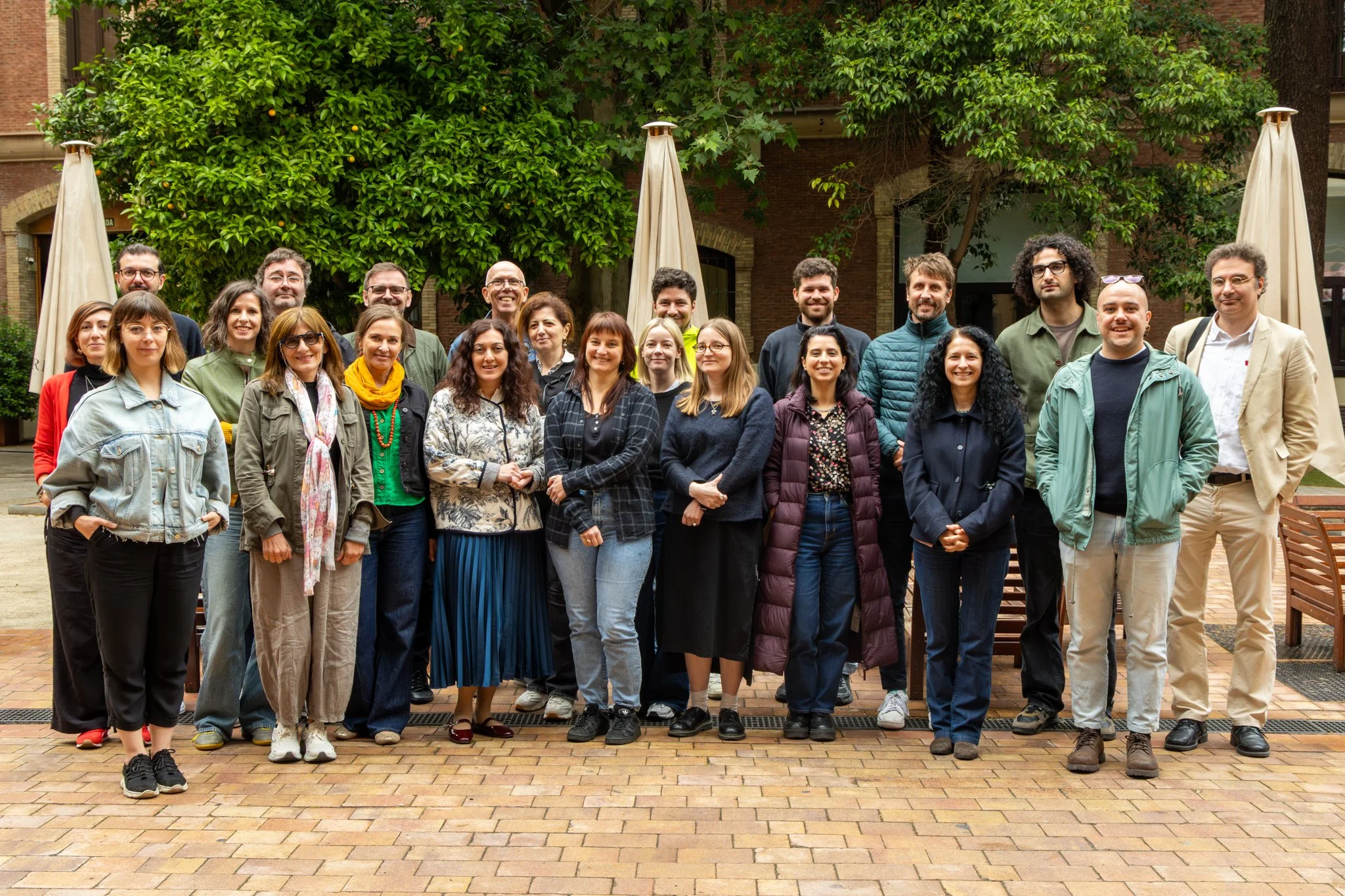
This year, the team met in a series of methodological workshops dedicated to critical discourse analysis, actor–discourse network analysis (led by Nino Abzianidze and Lia Tsuladze), and interviewing state officials. The in-person meeting held in Madrid on 7–8 May provided an opportunity to consolidate progress to date, discuss ongoing methodological challenges, and exchange solutions to practical research problems, as well as to plan the next stages of data collection and analysis.
NEXT STEPS
The next step in the project will be Work Package 5, which focuses on generational differences in perceptions of and participation in protest. Building on a Q methodology design, the research will examine how citizens from three generational cohorts (Gen X, Gen Y, and Gen Z) understand protest and how they engage in both institutional and non-institutional forms of participation, online and offline. The analysis aims to identify similarities and differences in generational attitudes and practices.
In future newsletters we will inform you about upcoming conference presentations, publications and the next steps within the project. Follow us on social media:
Facebook: @protest-project.eu
Instagram: @protest_project.eu
BlueSky: @project-protest.bsky.social