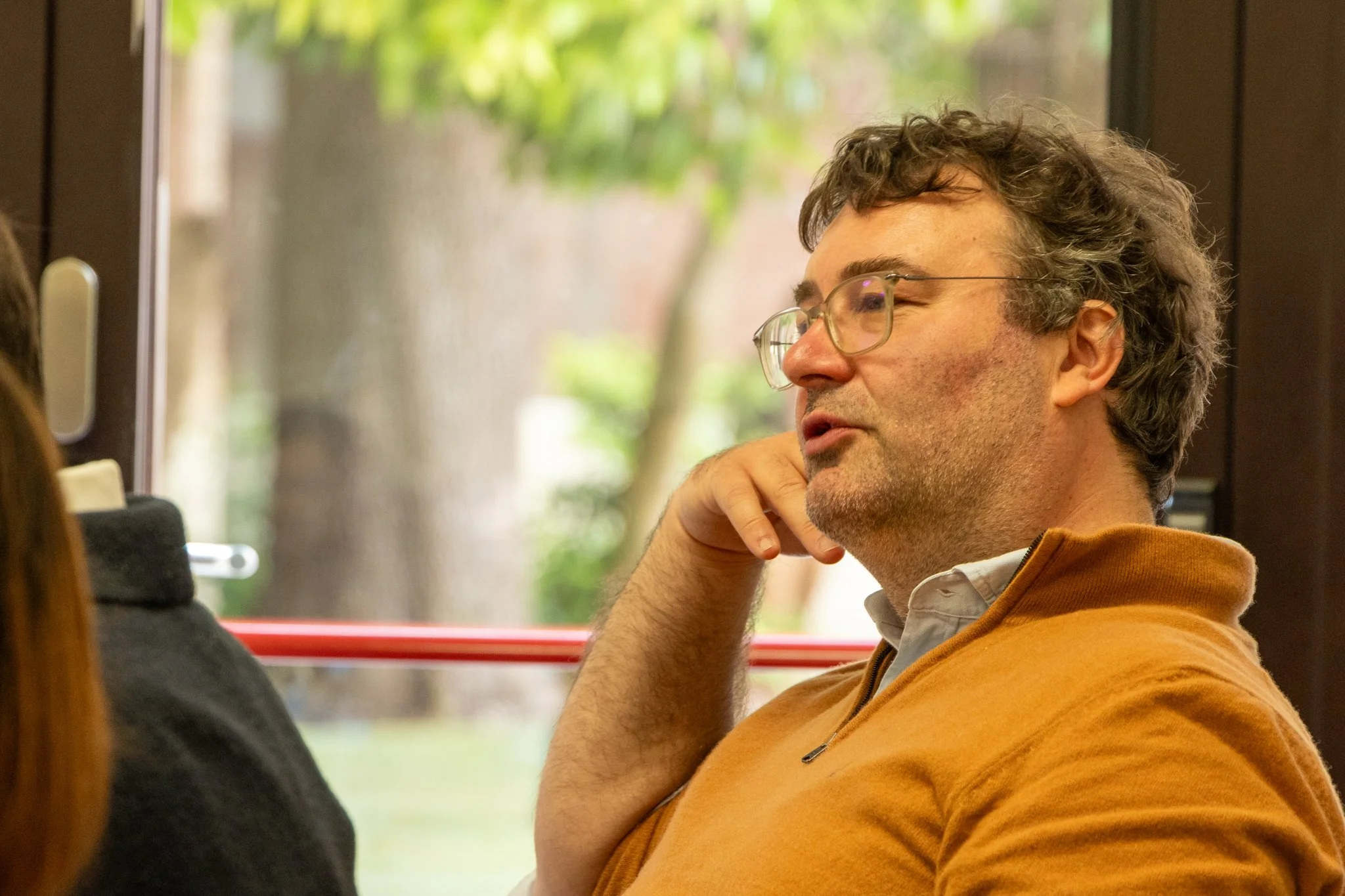
Team coordinator Henry Rammelt responds to questions for the Romanian team, which covers protest culture in Romania and Moldova. He has previously worked on protest movements in Romania and Hungary and youth participation. A second research focus is how corporations can be held accountable for human rights abuses, slave labor, and environmental degradation.
Besides Rammelt, the Romanian team consists of Dr. Vlad Bujdei-Tebeica, Dr. Mariuca Constantin, Dr. Claudiu Craciun, Dr. Monica Stroe, and Paula Erizanu.
Why is it important to study protest cultures and their interaction with democracy?
There are different definitions of democracy, and many approaches argue that elections alone are not sufficient. Democracy also requires legitimacy and a certain political culture. Some theories emphasize that active citizen engagement in political life is essential. This engagement takes place through political parties, but also through civil society organizations, social movements, and protest groups. These actors contribute to formulating ideas and claims about what politics should be, what governments should do, and what they should refrain from doing. In this sense, protests play an important role in shaping public debate and influencing political agendas beyond the formal electoral process.
Protest culture refers both to how people protest and to how states respond to those protests. It includes the issues people mobilize around, the repertoires they use, and the extent to which political institutions are responsive to claims emerging from society outside party politics. Protest culture can strengthen democratic resilience by challenging decisions that move a country away from democratic norms. This becomes particularly important in contexts marked by repression, shrinking civil liberties, or a narrowing space for civil society. At the same time, protest cultures are not necessarily democratic. They can provide legitimacy to political decisions, regardless of the direction, and as such also become a driver of de-democratization; notably if the respective protest culture is shaped by authoritarian attitudes, anti-democratic values, or exclusionary political behavior.
This is why the character of protest culture matters. Across Europe, we see democratic backlash and the rise of right-wing populism. When these developments are accompanied by pressure from the streets, political systems may have incentives to adopt less democratic practices while still claiming democratic legitimacy. Protest cultures develop over long periods of time, and some societies prove more resilient to these pressures than others. Studying these dynamics is therefore highly relevant, not least for the European Union. If electoral processes reveal worrying trends, it becomes important to understand which forces within society can be encouraged to strengthen democratic resilience and safeguard democratic institutions.
What movements are you studying?
We study both Romania and Moldova, but here I will focus primarily on Romania. Within the framework of this project, we examine actors that can broadly be categorized as pro-democratic and anti-democratic. In Romania, our research focuses on the recent surge of right-wing populism. The 2024 presidential election became highly contentious when a relatively unknown candidate unexpectedly won the first round. The result was later annulled by the Constitutional Court, triggering a series of protests and creating a highly polarized political atmosphere. Since that candidate could no longer run, another right-wing leader emerged, at the time heading the populist AUR party. Parliamentary elections held around the same period also saw strong performances by right-wing populist actors, further intensifying political tensions.
These developments generated significant mobilization in the streets. Large demonstrations were organized by the right-wing populist party and supported by actors within a right-leaning civil society, including groups with connections to religious communities. At the same time, there was a smaller democratic counter-mobilisation. The presidential election came to be framed, rightly or wrongly, as a choice between a European future and an alternative political direction. This framing led to several pro-European demonstrations, although these were generally fewer in number and smaller in scale than the right-wing populist protests. There were also minor incidents of violence connected to some of the right-wing demonstrations, including vandalism outside the electoral office in Bucharest and several smaller confrontations.
One particularly interesting aspect of the case concerns the unexpected rise of Călin Georgescu (the candidate that prompted the annulment of the first round of the Presidential elections). Although he had been involved in politics for many years, he was largely absent from opinion polls before the election and had only a limited presence in traditional campaign formats such as billboards and public advertising. Instead, his visibility came primarily through TikTok, where he built a large following and appeared to mobilize support outside the channels monitored by most political analysts. While it was already clear that the populist right was growing rapidly in Romania, his electoral success surprised many observers. He subsequently became a symbol around which narratives of electoral injustice developed, especially after the Constitutional Court annulled the first election round on the grounds of external interference. Because limited evidence was made public, some supporters continue to regard him as the rightful winner and see the annulment as proof that democracy is merely a façade. This perception has become an important part of contemporary right-wing political narratives in Romania.
This makes Romania a particularly relevant case study. It also explains my growing interest in populism as a research topic. These developments are likely to remain important far beyond Romania and will continue to shape political debates across Europe. Populism is already one of the most extensively studied political phenomena today because of its growing relevance. However, I hope this project can contribute additional insights into how democratic societies can respond to these challenges. Annulment of elections is probably not the best solution. Ideally, democratic resilience should be built before situations escalate to that point. A resilient political system would be preferable, but the next best thing is a citizenry that is unwilling to be pushed toward anti-democratic positions and capable of resisting such pressures.
In Moldova, the team is examining similar forms of electoral contention through the lens of pro-democratic and anti-democratic actors. One of their main cases concerns the presidential election of Maia Sandu, who was widely presented—and likely is—as a strongly pro-European candidate in contrast to her competitors. Their research traces these developments back to around 2016 or 2017, allowing them to study the longer-term evolution of political polarization, electoral conflict, and democratic engagement in the country.
What has surprised you during this research?
There are several developments that I find deeply concerning, although many of them were already visible before the project began. The most striking is the growing polarization of society. We see it not only in politics, but also in culture, social life, and public debates more broadly. Around the world, issues that might once have been considered relatively uncontroversial can now become highly divisive. This trend is particularly apparent in Eastern Europe, where societies increasingly appear divided into two opposing camps. This is not simply a narrative imposed by political actors; it is reflected in how people understand themselves and how they engage with politics. Many align either with a pro-European vision associated with liberal democracy or with populist leaders and, in some cases, more authoritarian alternatives. The degree of polarization is striking and appears likely to continue growing in the coming years.
Another important factor is the role of the internet. There was a period when many people viewed the internet as a force for emancipation and democratization. It was expected to broaden access to information and empower citizens. Increasingly, however, we are seeing the opposite tendency. The internet often contributes to social division and politicizes people in highly personalized and sometimes radical ways. What has surprised me most is the apparent lack of resilience many people display when confronted with disinformation and fake news. Information encountered online is often accepted without verification. A TikTok post, for example, may be treated as unquestionable truth simply because it is delivered by what appears to be an ordinary person.
This is particularly surprising because one would expect relatively well-educated populations to have stronger safeguards against misinformation and manipulation. Yet the influence of false or misleading information remains very strong. Overall, the most concerning trend is polarization, and much of it seems to be driven by algorithmic systems that reinforce existing beliefs and encourage increasingly segmented public spheres. As we learn more about the influence and ambitions of major technology companies, it becomes clear that these dynamics are not coincidental but designed to shape politics. Looking ahead, I think we face very challenging times.